We report the vapor phase synthesis and characterization of supported Pd, Au and unsupported bimetallic nanoparticle catalysts for
CO oxidation. The approach utilized in the present work is based on the laser vaporization/controlled condensation technique which
uniquely combines the features of pulsed laser vaporization with the controlled condensation process from the vapor phase to synthesize
nanoparticle catalysts of controlled size and composition. The results indicate that supported Pd/CeO2, Au/CeO2, and unsupported
bimetallic CuPd, CuAu, and AuPd nanoparticle catalysts exhibit excellent activity for CO oxidation. The significance of the current
method lies mainly in its simplicity, flexibility and the control of the different factors that determine the activity of the nanoparticle
catalysts.
Full Story
Tuesday, March 21, 2006

Microwave Synthesis of Highly Aligned Ultra Narrow Semiconductor Rods and Wires
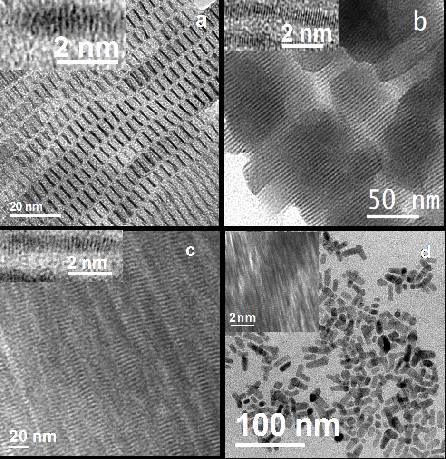
One dimensional nanostructures (rods, wires, tubes, ribbons) have recently attracted considerable attention. These nanostructures represent ideal systems for dimension dependent optical, electrical and mechanical properties, and are expected to play an important role as building blocks in devices and processes such as light-emitting diodes, solar cells, single electron transistors, lasers and biological labels.1,2 Many modern methods based on physical and chemical approaches have been developed for the synthesis of controlled size and shape of one dimensional nanostructures including, for example, vapor-liquid-solid and the solution-liquid-solid processes, solvothermal, template-assisted, kinetic growth control, self-assembly, and thermolysis of single-source precursor in ligating solvents.3 In addition to these methods, microwave irradiation (MWI) offers great advantges as the simplest and fastest procedure since selective dielectric heating, due to the difference in the solvent and reactant dielectric constants, can provide significant enhancement in reaction rates. Furthermore, MWI methods are unique in providing scaled-up processes without suffering thermal gradient effects, thus leading to a potentially industrially important advancement in the large-scale synthesis of nanomaterials. Although MWI methods have been demonstrated for the synthesis of a variety of high quality, nearly monodisperse semiconductor nanoparticles4, there are very few reports on the synthesis of one-dimensional semiconductors by MWI.3j-k,4 However, all the reported one-dimensional semiconductor nanostructures are wider than the Bohr radius, which limits the expected quantum confinement effects.
Full Story
A Room-Temperature and Microwave Synthesis of M-Doped ZnO (M = Co, Cr, Fe, Mn & Ni)
A room temperature and microwave method for the preparation M-Doped ZnO where M = Co, Cr, Fe, Mn & Ni is desribed. X-ray diffraction of the synthesized samples show a single phase ZnO structure without any indication of the dopant. Magnetic studies of the as prepared samples show it to be paramagnetic. However, hydrogenation of particular samples at 573 K for 6 hours resulted in transforming the samples to a room temperature ferromagnet.
Full Story
Full Story
Saturday, November 26, 2005
Sol–Gel Synthesis and Magnetic Studies of Titanium Dioxide Doped with 10% M (M=Fe, Mn and Ni)
TiO2 nanocrystals doped with 1%, 5% and 10% Co/TiO2 and 10% M (M=Fe, Mn and Ni) were prepared by the sol–gel technique and characterized using X-ray diffraction and SQUID. The as-prepared samples are found to be paramagnetic at room temperature, with the magnetic susceptibility following the Curie–Weiss law in the investigated range of 2–370 K. However, transformation from paramagnetism to room-temperature ferromagnetism (RTFM) for the 5% Co/TiO2 was observed by hydrogenating the sample at 573 K while the 1% sample remained paramagnetic. As the percentage of Co was increased from 5% to 10% the Curie temperature increased from 390 K to 470 K determined via extrapolation. Transformation from paramagnetism to room-temperature ferromagnetism (RTFM) was also observed by hydrogenation of 10% Fe/TiO2 at 573 K for 6 h. X-ray diffraction of the hydrogenated sample shows only single phase TiO2 structure suggesting that the observed RTFM may be intrinsic but
magnetic studies may suggest the possibility of Fe nanoparticles.
Full Story
magnetic studies may suggest the possibility of Fe nanoparticles.
Full Story
Friday, October 21, 2005
Microwave Synthesis of Supported Au and Pd Nanoparticle Catalysts for CO Oxidation
We report the microwave synthesis and characterization of Au and Pd nanoparticle catalysts supported on CeO2, CuO, and ZnO nanoparticles for CO oxidation. The results indicate that supported Au/CeO2 catalysts exhibit excellent activity for low-temperature CO oxidation. The Pd/CeO2 catalyst shows a uniform dispersion of Pd nanoparticles with a narrow size distribution within the ceria support. A remarkable enhancement of the catalytic activity is observed and directly correlated with the change in the morphology of the supported catalyst and the efficient dispersion of the active metal on the support achieved by using capping agents during the microwave synthesis. The significance of the current method lies mainly in its simplicity, flexibility, and the control of the different factors that determine the activity of the nanoparticle catalysts.
Full Story
Full Story
Nature of the reversible paramagnetism to ferromagnetism state in cobalt-doped titanium dioxide
We report that Co0.1Ti0.9O2 prepared by the sol-gel technique is a paramagnet following the Curie–Weiss law: x= x0+C/ (T+theta). However, hydrogenation at 673 K in H2/Ar 5% /95% gas converts a part of the paramagnetic sample to room temperature ferromagnet RTFM and reheating the sample at 573 K in air converts it back to a paramagnet completely. This reversible RTFM transition has been observed for additional cycles by alternately heating in air and H2 / Ar. It is argued that this RTFM is intrinsic and it is due to Co2+–Co2+ exchange interaction mediated by oxygen holes which are produced by hydrogenation but eliminated by oxidation.
Full Story
Full Story
Controlled transformation of paramagnetism to room-temperature ferromagnetism in cobalt-doped titanium dioxide

Samples of Co0.1Ti0.9O22 anatase prepared by the sol–gel technique are found to be paramagnetic at room temperature, with the magnetic susceptibility following Curie–Weiss law in the investigated range of 2–370 K. However, transformation from paramagnetism to room-temperature ferromagnetism ~RTFM! is observed by hydrogenation of the sample at 573 K. The increase in the hydrogenation time from 1 to 6 h increases the remanance, and the Curie temperature 470 K is determined by extrapolation. X-ray photoelectron spectroscopy and transmission electron microscopy of the hydrogenated samples failed to detect Co nanoparticles, suggesting that the observed RTFM in the hydrogenated samples may be intrinsic.
Full Story
Surface Enhanced Raman Spectroscopy Using Silver Nanoparticles: The Effects of Particle Size and Halide Ions on Aggregation

A surface enhanced Raman spectroscopy (SERS) investigation of the aggregation of silver nanoparticles formed via LVCC with diameters in the range 5–50 nm were studied. It was found that with 647.1 nm excitation maximum enhancement is observed using particles with 11 nm diameters. Upon addition of sodium halides, enhancement is proportional to the polarizability of the anion. Maximum enhancement was observed when the concentration of the anion is approximately equal to the concentration of the adsorbate.
Full Story
Formation of Cobalt Nitrate Hydrate, Cobalt Oxide, and Cobalt Nanoparticles Using Laser Vaporization Controlled Condensation

Herein, we report for the first time the synthesis of cobalt nitrate hexahydrate, cobalt oxide, and cobalt particles formed from a high purity cobalt metal by a novel laser vaporization controlled condensation (LVCC) method under controlled pressures of N2 and O2. The metal vapor produced from a cobalt target in the presence of 50% N2 and 50% O2 results in the formation of cobalt nitrate. We also explored the possibilities of forming cobalt oxide and cobalt nanoparticles by altering the ratio of N2 and O2 present. For example, the synthesis of pure cobalt oxide (CoO) nanoparticles is of importance and challenging since a simple chemical route is complex. We believe that this work will be of significant importance since the present method is promising for the synthesis of metal mono oxides.
Full Story
Thursday, September 29, 2005
Greetings
Welcome to the Blog dedicated to all things nano. As for myself, I am currently a post-doc at VCU researching nanoparticles as hydrogen storage materails and catalysts for CO oxidation.
Subscribe to:
Posts (Atom)